
useless action / harmless action: rainbow day and tishubuv

It's been a minute since I've written here. I've been consumed with a different project, directing a play. As such, I haven't managed to complete the post I started in June, which was about a ritual service I held in May.
In brief, my comrade Eli Newell and I held a small minyan in observance of Rainbow Day, a Jewish Renewal holiday which marks the date when the flood-waters receded and HaShem made a covenant with Noah, human beings, and all living creatures never again to destroy the world.
The post I was working on regarding that service was a lab report: what were we thinking, what did we try, and what was the result? I am interested in thinking more deeply about Rainbow Day as a protest holiday tradition-in-the-making, but now I've waited long enough that it's Erev Tishubuv, and I want to write about that, too.
Tishubuv is a difficult holiday for me, as it is for many of us, because it demands a specific affect. I have the same problem with Purim. I don't like being told when to feel happy or when to feel mournful, and even if I want to observe the day properly, I find that I'm resistant to it.
In a couple of hours, I'm going to go to a service where we will read Eicha and lament publicly in a square in downtown Chicago. This will be my third year participating in a Tishubuv service organized by fellow anti-zionist Jews. The virtue of mourning in public is clear. This is one of the many spiritual lessons that I have learned from Palestinians: crying is not surrender; mourning in public means insisting on grievability. There is great subversive potential in Jewish holidays of solemnity and mourning, in the context of a culture that permits the wheels of production to stop for no one.
The problem, I find, is (as Furman & Borinsky put it): "Are we actually sad what does it feel like to mourn on purpose on schedule are we faking it is this real grief." As an actor, I have a pretty good handle on how to summon sympathetic emotion to suit an occasion, and I also know that that's not the same as real mourning. Indeed, it's important (I think) to maintain a distinction between the mourning we do in solidarity and the experience of real bereavement.
Similarly, I am reflecting on the affective experience of Rainbow Day, a new Jewish holiday which attempts to confront the immanent and unfolding destruction of our world by human greed. The climate crisis, or what Rabbi Waskow z''l called Global Scorching, is a hyperobject, something that is impossible to hold in our minds all at once. This is where recourse to spiritual language is indispensable. For example, here is a passage from R. Waskow's prophetic Rainbow Haftarah:
I call you:
I, the Breath of Life,
Within you and beyond,
Among you and beyond,
[That One Who dwells between you and me]
That One Who breathes from redwood into grizzly,
That One Who breathes from human into swampgrass,
That One Who breathes the great pulsations of the galaxies.
In every breath you breathe Me,
In every breath I breathe you.
In the face of a problem so much larger than I can comprehend, I need recourse to a language that goes beyond the rational. I need language that reorganizes me physically; language which, through diligent repetition, will run through my blood and change the way I relate to my own body and the world around me.
The thing that these holidays have in common (and I acknowledge that one of them is very ancient and one is very new) is a feeling of uselessness. Tishubuv asks us to bear witness to the ongoing catastrophe of history; Rainbow Day asks us to renew our commitment to a terribly broken promise. Neither of these holidays has an active pose toward problem-solving, and adding in calls to action feels out of keeping with their spirit.
I'm reading this delightful book right now called Unheroic Conduct: The Rise of Heterosexuality and the Invention of the Jewish Man by Daniel Boyarin. In this book, Boyarin is reclaiming traditional Diasporic Ashkenazy masculinity which values study over activity, gentleness over aggressiveness, care and thoughtfulness over violence. His contention is that this counter-cultural model of masculinity has been misremembered, via postwar and zionist shame and repression, as an antisemitic stereotype rather than a real cultural value. In reclaiming this counter-masculinity (while also contending with the sexism of the culture from which it comes), Boyarin searches for a new model of liberatory queer Jewishness.
I'm finding the book very healing to read. It continually amazes me how much deep shame and denial is built into modern Jewish culture, to the point that much of what we think of as our culture is actually our parents' and grandparents' rejection of their/our ancestors. In many of the texts that Boyarin examines, Eastern European (as opposed to German & later American) Jewishness is figured as backward, un-Western, and un-modern. Assimilation into bourgeois Western gender roles is figured as "modernization." (His twin examples of this desire to modernize/Westernize/masculinize the Jew are Freud and Herzl, who shared a loathing for traditional Jewish culture.)
As we now live in the ashes of Western modernization, clearly something else is needed.
One of the resonances this book is having for me is my compulsive tendency toward action, usefulness, pragmatism. What can I do to help? This is my kneejerk response to any painful feeling or bad news. Friends and lovers have told me more than once that this habit is frustrating, as it blocks me from being a compassionate listener. While I honor that my desire to be of use has led me toward many righteous actions, it also sometimes makes me run myself into the ground and cuts me off from other people.
One of the hallmarks of the traditional cultural values that Boyarin is exploring is that study is sacred for its own sake. Study is best if it leads to action, but we cannot know in advance what kind of action it will lead us to, and we have to trust that every piece of Torah is infinitely worth studying.
Reading about this traditional repudiation of the European ideal of active, violent masculinity has helped me to understand what it means that urgency is a tenet of white supremacy.
I wonder if the challenge of each of these holidays, for me personally, can be letting go of urgency--in a way that is explicitly not comforting. I usually think of letting go of urgency as a pacifying tool, but in my own life, it might be urgency itself which is pacifying, which prevents me from looking directly at the truth.
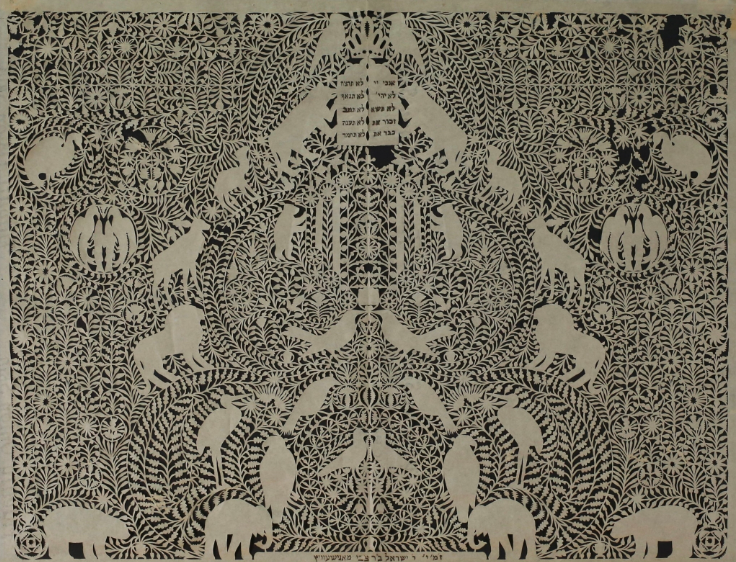
As I've mentioned here before, my partner is a Buddhist, and one of the many pieces of wisdom he has shared with me is the concept of Cunda, harmless action. Harmless action is a kind of skillful action. As I understand it, the concept of harmless action means that there is value not just in helping, repairing, or acting righteously, but there is also value in neutral activities that lead us toward more skillful states of mind, in which we are less likely to cause harm. One example he showed me is a kind of meditative doodling, which made me think about Jewish papercutting. Focusing on a careful, delicate, beautiful activity might not lead to anything useful (it might not even lead to a useable decoration), but if it calms and focuses my mind, making me less likely to cause harm, it is valuable in itself. Not everything needs to be productive.
Degrowth is a philosophical stance that is almost unthinkable; to riff on Le Guin, it asks us to imagine our way out of the divine right of kings. Committing to degrowth means committing yourself to a philosophical attitude you know is not politically practical, not within the realm of currently acceptable discourse, but (as Wilde says) has at least the minor merit of being true. That this is a Jewish attitude is something I am re-discovering. I believe with perfect faith in the dawning of a better day; and, though it tarries, nevertheless I yearn every day for its arrival.
With all that being said, since it is Tishubuv, I want to take the last part of this post to look at something horrible, without looking away and without shifting into a message of uplift or problem-solving.
Yesterday, the al-Masri family, a family of six, was killed all at once in Gaza City when the Israeli miliary firebombed their home. Salsabeel al-Masri was killed. Her husband, Firas al-Masri, was killed. Their four children, Faryal, Salma, Amira, and Naim, were killed. Firas' brother Mohammed Al-Masri said, "They burned before our eyes and we couldn't do anything." He went on to say, "The whole world is watching us. There is no ceasefire in effect, the war hasn't stopped, and no one cares about us."
You can see a video of the funeral procession for the al-Masri family, and learn more about the ongoing attacks on Gaza, including an attack on a funeral procession last Friday in which at least eight were killed, in this article. I recommend trying to read the whole article all the way through without skimming any of it or switching away to a different tab.